
Eagles' Wings Flight Training
Serving the Beautiful Greenbrier Valley of West Virginia since 1984
Serving the Beautiful Greenbrier Valley of West Virginia since 1984
This is a brief summary, or over-view, of this subject. It is meant to be an introduction only. For full details you should consult the Federal Aviation Regulations, Part 61. If you have questions, please feel free to contact me: David@EaglesWings.net
NOTE: The pronoun "he" is used on this web site in the generic sense, meaning all people. It is in no way an inference that pilots should all be men. My primary instructor was a very competent woman, Ruth Tolley Gwinn. Later, in preparation for my instrument rating, commercial license, and instructor's certificate, I received many hours of instruction from Merry Casto. Since then, I have taught many teenage girls, ladies of all ages - even at a couple grandmothers!
Whoever you are, welcome to the air!
A young person, under US law, may begin taking flight training at any age, but must be at least 16 years old to solo a powered aircraft. Before solo flight they must have a Student Pilot Certificate. Since 2016, student pilots get a plastic "student pilot certificate" directly from the FAA district office. They are no longer issued by the Aviation Medical Examinar in conjunction with the Third Class Medical Certificate. You apply online, (FAA IACRA website), and receive it in the mail. You must have the student certificate, and a Third Class Medical Certificate, before you fly solo in a powered aircraft. Solo means to fly alone, as the only occupant of the aircraft. A student pilot cannot act as "pilot in command" of an aircraft carrying any passenger, except when carrying a Flight Examiner during an official "practical test." The purpose of the Student Pilot Certificate is to receive training, and allow solo experience, in preparation for a higher class license.
Since students may solo a glider or balloon at age 14, they may register as an IACRA user as young as age 13, but they must be within 90 days of their 14th birthday to apply for a Student Pilot Certificate. If you have no plans of soloing gliders or balloons at that age, you may wait until closer to your 16th birthday to submit your application for a Student Pilot Certificate.Be sure to visit and read the "Getting Started" page of this website. CLICK HERE.
Since the PRIVATE PILOT'S LICENSE is considered to be the "standard license," let me mention that first. The Private Pilot license allows one to fly unlimited distances, day or night, fly airplanes with any number of seats (usually this will be 2, 4, or 6), and carry any number of passengers, appropriate for that aircraft of course. The aircraft can be flown in furtherance of a business - just as long it is not a flying business. An Instrument Rating can be added to allow flights in restricted visibilities such as clouds, smog, haze, and heavy precipitation.
For decades, the Private Pilot Certificate has been the "standard" pilot's license. Most trainees continue to go for this option. See: Private Pilot Requirements.
There are a couple "lower" license categories which require somewhat less training, experience, and cost, but of course they do not grant the same priviledges as a Private Pilot's License. There is surely a level of license to meet your needs.
The Recreational Pilot Certificate was established in 1989 to allow a less expensive, and "easier to obtain" basic pilot license for those who want to fly for recreation only. It allows the pilot to fly, day time only, in aircraft having up to four seats, but only one passenger may be carried at a time. The holder of such a license must stay within 50 nautical miles of his home airport, unless he has had additional training in cross-country navigation. He may not fly at night, nor without visual reference to the ground, and may not fly in furtherance of a business. There have been attempts to modify the regulations, perhaps making this class of license more desirable. BUT... read on.
A recent inquiry to an FAA web site revealed that as of the end of 2025, there were no more than 127 holders of Recreational Pilots certificates in the United States. This number had been well over 300 for several years, in the 1990s, but has steadily declined since the Sport Pilot Certificate became available in 2004. It has never been a very popular option, despite a few regulatory changes to make it more attractive. Some have used it as an advantageous stepping stone toward the Private Pilot's license.
Recent changes in the Regulations have made the Light Sport Pilot Certificate even more atrractive. The Regulatory changes of MOSAIC in October 2025 have removed the restiction which limited Sport Pilots to 2-seat aircraft weighing up to 1320 pounds, maximum cruise speed of 120 knots, and some other basic limitations.
Those restrictions are GONE! A Light Sport Pilot licensee may now fly many heavier aircraft, and the criteria are no longer based entirely on aircraft weight, but on stall speed. A person flying with Sport Pilot Privileges may now fly a 4 or 6 seat airplane, under some circumstances, BUT ONLY WITH ONE PASSENGER AT A TIME.
In most cases a medical certificate is not required. Many people who already have a higher class of license may continue flying aircraft in this category, using only their driver's license as medical certification. Other new pilots may not need any medical certificate except a valid driver's license. The Sport Pilot's License went into in 2004, but these recent changes make a more attractive option for some people.
Statistics indicate that there have been no increase in accident rates caused by the fact that these Sport Pilots are not required to have FAA-issued medical certificates. Many older Classic airplanes have been flown in the Sport Pilot category as well as a great number of very modern aircraft, such as this CTLS pictured below. CTLS stands for Composite Technology Light Sport.
The New MOSAIC regulations are still in a "state of fluxuation" so some details still need to be clarified by the FAA and insurance companies.
Continued below the pictures
Pictured above, is our Papua New Guinea daughter, Hannah Keru Siminji, who completed her Private Pilot's License in 2001. She is now married, has five children, and operates Lighthouse Christian Academy in Port Morseby, the capital city of PNG.

This is flight examiner, Don Judy, with a new Private Pilot, Andrew Dowdy, age 17, after his successful "practical test," in September 2016. The practical test is partly oral, and partly actual flying. The examiner must determinre the applicant's qualifications in knowledge, skills, and judgment.

Danielle Price was with me for my 5000th hour as a flight instructor in June 2017. She had soloed the month before. She now lives in Vermont.

This is teenage pilot, Malachi Kratz, after his first solo flights, October 26, 2017.
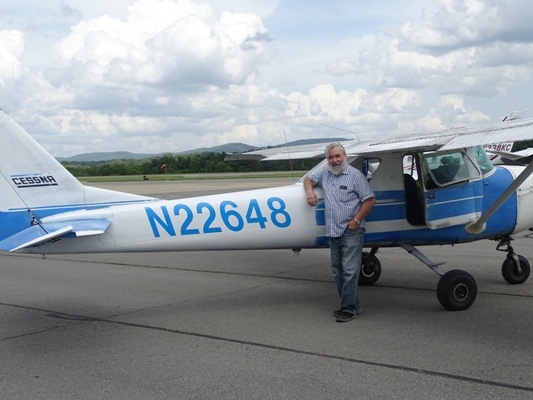
Here I am with the new numbers on our Cessna 150 after my wife, Crystal, and I striped that area down, on both sides, and repainted it, June 2019.We continued working on it until we had done the entire fuselage. Having been based there since 1986, and used for so many hours of flight instruction, this airplane has undoubtedly made more landings at Greenbrier Valley Airport (LWB) than any other airplane.
The Commercial Pilot Certificate requires more training, but allows one to fly for hire - for pay. Contrary to popular belief, among non-aviators, this does not qualify you to fly all kinds of jets, nor hold every kind of flying job! It could be considered as a very essential step in that direction. A Commercial Pilot Certificate demonstrates that you have acquired more advanced skills and knowledge, and can be PAID to fly under some circumstances.
In the United States all pilots are encouraged to get additional training, and obtain instrument proficiency, and/or a commercial pilot's license. The additional training and experience will help you become a better, safer, and more versatile pilot.
Persons wishing to fly large aircraft for hire, such as airliners or passenger jets, must have at least 1500 hours of flying time, and obtain an Airline Transport Pilot Certificate.
To fly any jet aircraft, or aircraft weighing over 12,500 pounds (5700 kg), a pilot must also have a Type Rating for that make and model of aircraft.
Since this Web site caters to many in the "new to aviation" category, we will focus our attention, at this time, on the Requirements to obtain a Private Pilot Certificate.